
Research Article - (2021) Volume 13, Issue 5
This Commentary presents the background, summary, and conclusions of a recently published article on preclinical studies of disease suppression by immunomodulatory peptide vaccines in mouse models of rheumatoid arthritis (RA). RA represents one of the most comm on autoimmune diseases that severely impact the quality of life of patients and put huge burden on healthcare. Therapeutic options are available to treat RA, ranging from over-thecounter anti-inflammatory drugs to classical immunosuppressants and newer inhibitors of inflammatory cytokine pathways. Unfortunately, 30-50% of RApatients do not respond effectively to current treatments. Based on the guidelines of the European League Against Rheumatism (EULAR) and the American College of Rheumatology (ACR), once a diagnosis is established, therapy should start with a conventional synthetic disease-modiyfing anti-rheumatic drug (csDMARD) such as methotrexate or leflunomide. These drugs elicit general immune suppression but side effects are very common with extended use, and several drugs in this group are contraindicated during pregnancy. If adequate remission is not achieved by csDMARDs, a biologic DMARD (bDMARD) is the next option. bDMARDs include soluble cytokine receptors, receptor antagonists, and monoclonal antibodies against single cytokines, cytokine receptors, or other cell-surface molecules. These agents primarily act by neutralizing the action ofa particular cytokine or a cell-surface receptor and as such, they are not disease-specific. Janus kinase (JAK) inhibitors represent a class of targeted synthetic DMARDs( tsDMARDs). JAK inhibitors act intracellularly and inhibit the downstream signaling of several pro-inflammatory cytokines. These therapies are not ideal because they are either limited to treating they msptoms or they ablate inflammatory pathways that are important for critical immune functions and hence suppress necessary responses that fight infections or prevent tumor development.
Peptide vaccine; Immunotherapy; Rheumatoid arthritis; Animal models
Therapeutic vaccines represent a new approach to the treatment of autoimmune conditions. Unlike conventional vaccines, which activate antimicrobial antibody and proinflammatory T-cell responses, therapeutic vaccines activate T-cell mediated responses that modulate ongoing pro-inflammatory pathogenic processes to suppress the diseasespecific immunopathology [4].
The Ligand Epitope Antigen Presentation System (LEAPS) provides a platform to design antigen-specific therapeutic vaccines customized to modulate the pro-inflammatory response driving the disease. LEAPS vaccines consist of an immune cellbinding ligand (ICBL) attached through a triglycine linker to a peptide containing a T-cell epitope.
The J ICBL directs the immune response to elicit an interleukin (IL)-12 and interferon gamma (IFNγ) T helper 1 (Th1) cell driven response, whereas the DerG ICBL directs the vaccine to Th2 or regulatory (Treg) cells and elicits an antigenspecific IL-4 and IL-10 production [5,6].
Our recent study [1] demonstrated the therapeutic effect of two DerG-LEAPS vaccine formulations containing distinct cartilage proteoglycan (PG, aggrecan) epitopes, separately and in combination, on the G1 proteoglycan domain-induced arthritis (GIA) model of RA.The GIA model is established in aging female BALB/c mice, is driven by (Th1) proinflammatory responses and the resultant symptomatology and disease parameters closely resemble the human disease [2]. The first vaccine, DerG-PG70 (also referred to as CEL-4000, the DerGPG peptide administered with adjuvant), contained the most immunogenic epitope of the G1 domain of PG, and was shown to suppress ongoing arthritis by down-modulating proinflammatotory Th1 and Th17 immune responses in the GIA and proteoglycan-induced arthritis (PGIA) mouse models [7]. The other vaccine (DerG-PG275Cit) contains a citrullinated PG epitope which is immunogenic in mice with PGIA as well as in human RA patients [8].
In the most recent study [3], the efficacy of the two vaccines was compared by treating mice already exhibiting the disease symptoms of GIA. Each of the vaccines, separately, as well as in combination, reduced the severity of disease, as indicated by the visual arthritis scores, and also reduced tissue damage, as confirmed by histopathology, in comparison to control mice treated with adjuvant without LEAPS peptides. In order to determine how the vaccines modulated disease progression, we investigated their effects on intracellular antiinflammatory and pro-inflammatory cytokine content as well as cytokine release of CD4+ spleen cells of the GIA mice. These cells from treated mice preferentially produced anti-inflammatory (IL-4 and IL-10) rather than proinflammatory anti-inflammatory (IL-4 and IL-10) rather than proinflammatory (IFNγ or IL-17) cytokines in culture. Similarly, cytokines secreted by CD4+ cells of unvaccinated GIA mice, but differentiated in vitro to Th2 cells and treated with either or both DerG vaccine peptides, exhibited an enhanced anti-inflammatory (IL-4, IL10) profile. These results indicate that the vaccines provide therapy by reinforcing beneficial anti-inflammatory cytokine responses rather than the pro-inflammatory responses. Although antibodies against vaccine components should not contribute to the therapeutic effect, analysis of the antibody response to the vaccines did indicate differences in the mode of action for CEL-4000 and DerG-PG275Cit. Whereas sera from CEL-4000 vaccinated mice contained antibodies to both the DerG and PG70 components of the vaccine, antibodies to neither peptide were detected in the sera of DerG-PG275Cit vaccinated mice. Serum antibodies from GIA mice in the combined vaccine treatment group resembled those from mice treated with CEL-4000 alone.
CEL-4000, DerG-PG275Cit and the combination of these peptides elicit an immunomodulatory therapy in mice with RAlike arthritis driven by pro-inflammatory Th1 responses. The combination of these DerG-LEAPS vaccines may provide greater epitope coverage and efficacy in RA patients than either vaccine alone. They join the J-LEAPS (CEL-2000) vaccine that is effective in treating collagen induced Th17-driven arthritis in mice (Figure 1). These peptide vaccines differ from other approaches to the treatment of RA in that LEAPS vaccines are antigen and cytokine response specific. They modulate the overall antigen-specific immune responses that drive the disease rather than nonspecifically ablate a single cytokine or cell type, or inhibit RAunrelated inflammatory immune responses. LEAPS vaccines also provide the ability to customize therapy for a patient depending upon the antigen and the pro-inflammatory cytokine response driving the disease. Therefore, LEAPS vaccines have the potential to maximize therapy and minimize ablative immunosuppression.
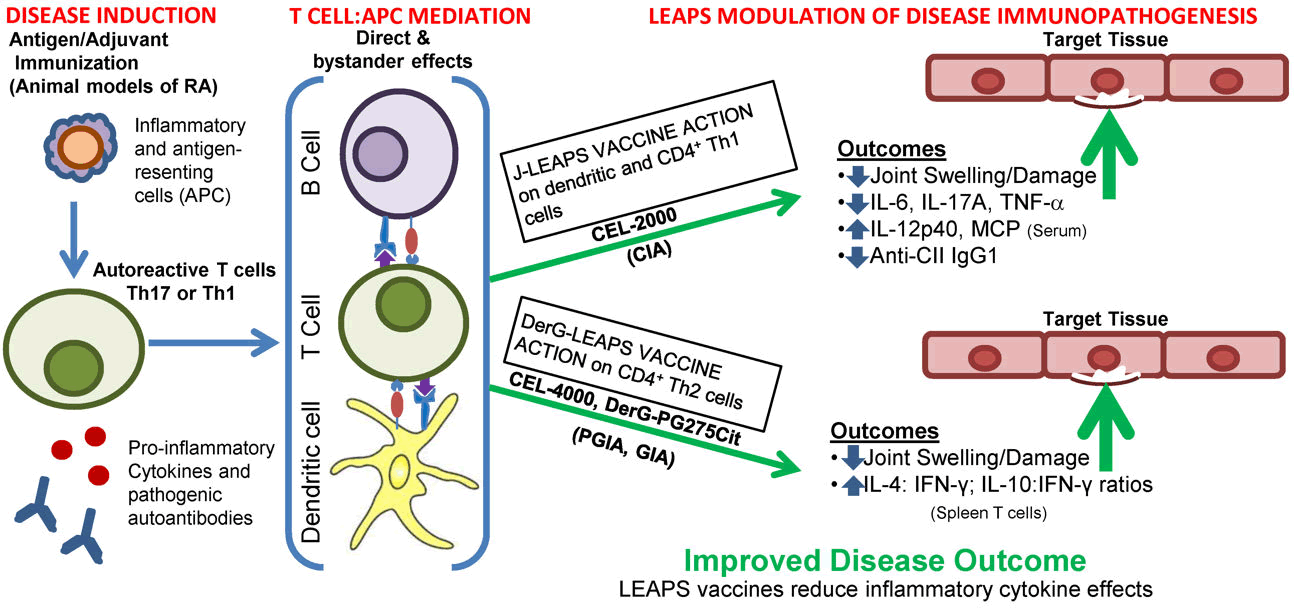
Figure 1: Schematic representation of the immune responses modulated by LEAPS therapeutic vaccines in animal models of rheumatoid arthritis (RA). CEL- 4000 and DerG-275Cit are DerGLEAPS peptide conjugates containing different proteoglycan epitopes. These vaccines separately or in combination blocked disease progression in the pro-inflammatory T helper 1 celldriven GIA model of RA. In an earlier study, a J-LEAPS vaccine containing a collagen II epitope, was therapeutic in the Th17- driven collagen-induced arthritis (CIA) model of RA [6].
Citation: Markovics A, Z immerman D H, Mikecz K, Rosenthal KS(2021) Suppression of Arthritis by Immunomodulatory LEAPS Peptide Vac cines in Animal Models of Rheumatoid Arthritis. Int J Drug Dev & Res Vol: 13 No: 5
Received: 19-Sep-2021 Published: 18-Oct-2021
Copyright:This is an open access article distributed under the terms of the Creative Commons Attribution License, which permits unrestricted use, distribution, and reproduction in any medium, provided the original work is properly cited.
